
Some highlights and hopefully helpful notes from our first year of monetization on YouTube.
I’m writing this partly for myself but mostly for someone like me from 2 years ago, who’s considering starting a YouTube channel doing scratch tickets or similar content and is wondering if it’s worthwhile or potentially profitable.
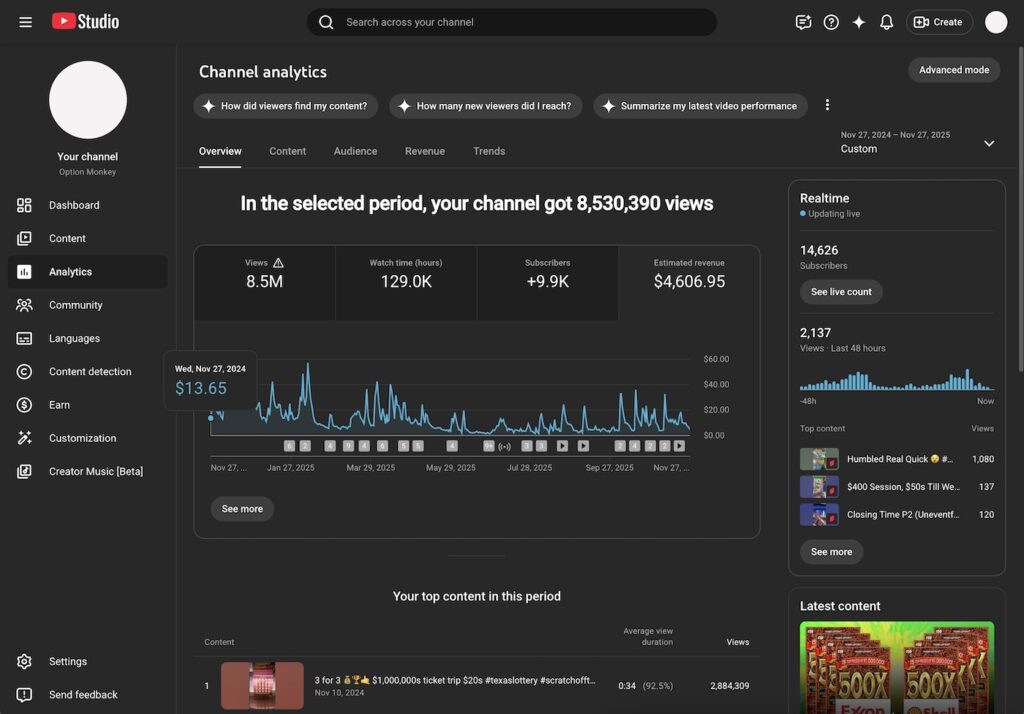
It’s a blast most of the time, and earnings have outdone my expectations, but no part of what we do is net profitable yet.
The returns/winnings from scratch off tickets themselves have also outdone my expectations: Sure, we’ve lost a lot more than we’ve won or may ever win back, but the ROI from scratch offs is still higher than I expected—not that I recommend anyone scratch tickets, I don’t; to each their own.
What YouTube Paid Us
| Month / Date Paid | Payment (Ad Revenue Only) |
|---|---|
| Apr 15, 2025 | $1,976.03* |
| Apr 21, 2025 | $349.33 |
| May 21, 2025 | $609.01 |
| Jun 22, 2025 | $268.12 |
| Jul 21, 2025 | $135.89 |
| Aug 21, 2025 | $177.28 |
| Sep 22, 2025 | $238.75 |
| Oct 21, 2025 | $172.93 |
| Nov 21, 2025 | $401.34 |
| Year 1 Total | $4,328.68** |
* Not a single month’s earnings, but the total to date from when we became monetized, 27 Nov 2024 → 15 Apr 2025. (You can set a payout threshold in Google AdSense, or stick with YouTube’s default minimum payout threshold of $100.)
** -$278.27 less than the 1st Year figure in screenshot above, because this table is based on deposits which happen the month after earnings. In November, for example, creators are paid October’s ad revenue.)
(Bear with me, this is a work in progress, be done by end of January.)
KEY METRICS:
So that I’m not selling you a dream—and I’m not actually selling anything or suggesting anyone do this—I want to be very clear about how much money has been invested, made, and lost here.
These are slightly different timeframes than our first full year of being monetized, because we had to invest to get to the point we even qualified to be monetized.
So, we:
- Spent $88,568.00 on scratch off tickets from 7 June 2024 → 4 Nov 2025.
- Won Back $68,817.00 on scratch off tickets from 7 June 2024 → 4 Nov 2025.
- Lost $19,751.00 on scratch off tickets from 7 June 2024 → 4 Nov 2025.
- Made $4,606.95 from YouTube ad revenue in year one, from 27 Nov 2024 → 27 Nov 2025.
- For a Net Loss of $15,144.05 (which is the $19.75K lost to tickets, offset by the $4.6K earned on YouTube).
It’s important to understand: a) that we’re still not profitable—nothing we’ve done to date is net profitable, which is okay, because we loved it—but also, b) that we needed roughly $20,000, not $88,500, in available capital to get here, because scratch tickets are themselves a form of potential money—i.e., not every dollar spent on them is automatically a sunk cost or a true loss.
“No Ragrets”—Not Even a Letter
The whole process of both Scratch Off Tickets and YouTube is a blast for me. Picking tickets, scratching tickets, editing videos, ticket “logic,” tracking ticket outcomes, trying new scratch styles and video ideas, meeting other scratchers in person and on YouTube, reading and responding to most YouTube comments. It’s all pretty unique and exciting and a nice escape/addition to IRL life and friends.
People have sometimes commented, “you know you’ve got a [gambling] problem when you don’t even scratch the dang ticket…” which is partly understandable, and I imagine denial is a big part of not recognizing you have an actual problem. But even if you remove the money from it all, this is all very fun sh*t to do. It’s a f—ing blast! Have I ever gone over budget? Of course, but I’m as “addicted” to scratching tickets as I am to YouTube or to “being successful” in life. All usually a blast. No Ragrets, not even a letter.
TIMELINE:
I. From 1st Video to 1st Dollar
| Date | Milestone |
|---|---|
| 2020: | — |
| November 27, 2020 | Channel started, 1st video posted (on options trading). |
| December 12, 2020 | 3½ year break. Work, kids, covid world, etc. Had 4 videos up. |
| 2024: | — |
| June 7, 2024 | 1st scratch ticket video. It was terrible lol. |
| October 3, 2024 | YouTube glitch, “channel terminated” — widespread error, briefly terrifying. |
| October 4, 2024 | 500 subscribers, email from YouTube. |
| October 17, 2024 | 2,000 subscribers, app notification from YouTube. |
| October 28, 2024 | 1,000,000 views on a Short, app notification from YouTube. |
| November 4, 2024 | 3,000 subscribers, app notification from YouTube. |
| November 18, 2024 | 4,000 subscribers, app notification from YouTube. |
| November 19, 2024 | Monetized. Tier 1, Super Chats, but not ad revenue. |
| November 27, 2024 | 1st $1 made: $13.65 in ad revenue earned on day one = 173 days (or 5 months and 20 days) from our first video to our first day of earning ad revenue. |
| December 2, 2024 | 5,000 subscribers, app notification from YouTube. |
| 2025: | — |
| January 17, 2025 | 10,000 subscribers, email from YouTube. |
| November 27, 2025 | $4,606.95 earned on YouTube in year one. Net loss, but awesome + fun. |
First Video on the Channel: November 27, 2020
We’d posted some options trading videos on this channel in November and December of 2020. Good videos, fun to do, but they took too long to plan, film and edit, so with the limited time we had, would likely never get monetized. There are also far better options trading channels out there — Project Option and InTheMoneyAdam. We still trade options, but don’t make videos on it.
First Scratch Off Ticket Video: June 7, 2024
In June 2024, we scratched our first Texas tickets and decided it would be fun to share on YouTube. Between then and November 2024, we’d started scratching differently than anything we’d seen on YouTube, not to be different, but because with the time we had available (job, kids, volunteer work), it was faster and funner to stand in front of machines and chase tickets to the first win. We also started logging the outcome of every ticket played.
Channel Removed from YouTube—Psych! October 3, 2024
On October 3, 2024, a ton of YouTube channels received an email saying their channels had been banned and removed from YouTube for “…severe or repeated violations of our spam, deceptive practices and scams policy. Because of this, we have removed your channel from YouTube.” We were one of them and reading this email in HEB parking lot was devastating. Thankfully, YouTube later announced it was a systems error that affected a ton of channels, which were restored.
First Day Earning on YouTube: November 27, 2024
We made $13.65 on November 27, 2024, and $4,606.95 within our first year (Nov 27, 2024 – Nov 27, 2025), an average of $12.62 per day. Cool, but a net loss due to ticket spend, though great to be paid for what were previously doing for free.
TAKEAWAYS:
II. Thoughts, Challenges
Shorts grew our channel.
Most of our early videos were Shorts, and a handful of them blew up and each attracted enough subscribers to meet the subscriber count monetization threshold. We hit our subscriber requirement of 1,000 subs a bit before hitting our watch time requirement or 4,000/hrs in 365 days.
Shorts might also have pigeon-holed our channel.
Shorts were the best format for the type of scratching we were doing at the time, which was scanning barcodes while standing in front of a machine. Very fun. But that possibly put us in front of viewers who wanted fast-paced slots and gambling content, rather than the more traditional method of actually scratching tickets at home. Not terrible, but it did give us a majority of subscribers who were, I think, less likely to sit through a full pack of tickets being scratched.
pi·geon·hole (/ˈpijənˌ(h)ōl/) v.: assign to a particular category or class, especially in a manner that is too rigid or exclusive. – Oxford Languages
To test this theory, we set all our Shorts to “Private” for a while, but it made no difference.
We do what we do because it’s fun, but if it’ll make money meanwhile, even better. So at one point, we set all of our past Shorts to “Private” or “Unlisted.” This dropped our coveted “Total Views Count” from 11,000,000+ to somewhere around 2M if I remember correctly. A month later, no major difference in viewership so we reset the Shorts to “Public.”
At one point, a 2nd scratch channel we started for testing was outperforming our main channel.
Testing this theory that our Shorts had put our long form content alongside faster-paced slots and casino content, we started a brand-new channel and uploaded one video a day for about 14 days. Four or five days into this, that brand-new channel was getting more views than our main channel, even though it had several thousand fewer subscribers. We paused that channel but it gave us some good info.
Giveaways were, unfortunately, a mistake.
When you start getting paid for what you were previously doing for free, you might feel obligated to thank those who got you there. We did, and we spent over $500.00 on giveaway tickets, which we’d scratch on screen and then CashApp any money won to the winners. Roughly 10-12 people won these giveaways and were paid via CashApp.
Of the 10-12 winners, 4 of them later sent CashApp requests to me asking or begging for money—for a haircut, a “job interview,” or to just be a nice person. Probably not the type of viewer worth appealing to.
In contrast to our giveaways that I think were a failure, Get Rich or Die Scratching does giveaways that I think are great.
And the differences between his and ours are:
- Our giveaways were done on vertical Livestreams, which attract very casual or random viewers. His are done on horizontal livestreams, well into the stream, where he goes from scratching to the giveaway. Basically, I think his format is better at adding another reason to watch, whereas ours inadvertently ended up as sort of the only reason to watch—even if you weren’t interested in scratch off tickets, why not stay a few minutes and win up to $500? If we missed a ticket win and pulled the ticket out of the screen as a loser, whoever spotted the missed win first won whatever the ticket won.
- He also enables or has Channel Memberships, and uses part or all of the revenue from that to gift tickets to members. We haven’t enabled Channel Memberships.
- For the most part, giveaways are very rare (and rightly so, since the creator is also spending money to buy tickets). Fixin to Scratch, ARPlatinum, and many other large channels don’t do giveaways, and instead just put on a good show and post consistent content.
Great Community, Tap Into It
The scratch channel community on YouTube is great: closely connected, uplifting and supportive of others for the most part. (There’s occasional drama, but the community as a whole is a definite net positive.) In the early days, I often held back from commenting on other scratcher’s videos as I didn’t want to come across as capitalizing on or taking advantage of the viewership they’d built up over so many years, but this is likely a goofy concept and was all in my head only. Though I watched almost all of their videos for context, tips, inspiration, I never commented or encouraged. Eventually I settled on commenting and more openly supporting other creators in the space. It was all in my head, but in the end I’ve never felt quite part of the community, probably because our Barcode Junkie™ scratch style was so unordinary and jarring to scratchers who savored the scratching. Or because I’m so pressed for time that I’ve yet to connect with many of them. And over time, I also realized I liked scratching tickets the good old fashioned way, though machines and chases are wild and fun.
Regrets vs Would Do Again
“Regret” isn’t quite the right word as the learning experience from each of these was worth going through, but here’s what I would and would not do again if I were to start over.
YouTube Shorts — Would Do Again
Shorts are a great way to build a channel, and once you’re monetized you can always further “train the algorithm” with long form videos, or whatever it is you want viewers to watch, say, for instance, some form of content you realize makes you the most money, or the content that you enjoy creating the most. There are people who think YouTube Shorts tank a channel’s overall views, which I agree with for the most part, but I’d still do them again as the fastest way to grow and get monetized. Prior to being monetized, the content you create won’t make you money (unless it’s later viewed after you’re monetized), but once you’re monetized, any content you create should earn at least some money. (We’re spending so much time on money and ad revenue because I’m writing this for someone looking at the economics of getting started, but I also do think you have to have your “heart in the game” with whatever content you create, and that the best creators really connect with their audience in some way: you can’t reduce this all down to robotically and silently scratching tickets (even though our silent long form videos have the most views, I think you get the idea.)
Barcode Scratching — Would do again.
This is standing in front of a machine and just scratching and scanning barcodes, often chasing one or more tickets (games) to the first win. Very fun. Very unique. People also like to see how a ticket won whatever it did, especially the larger prizes, so it’s best to reveal that too, not just show the green screen.
Video Costs; Expensive Not Always Better
People love watching the higher-priced tickets ($20, $30, $50, or $100), but these videos don’t always make vastly more money than a good lower-priced ticket does. I tried going Live at 11 am for somewhere around 15 days to see if that would catch on, but it didn’t. Ultimately, I try to do a) What I like doing or want to do (full books, 4 tickets each from 4 different packs, Loteria, etc., b) What I can afford to do, while c) Putting on the best show possible, which others are better at than I am but I do my best and it works.
Taking Breaks from Scratching & from YouTube — Would Do Again
I’d do this again and I think it’s pretty important, but I would probably not take as long of a break as I sometimes have. You’ll get people who you start to feel like you know, connect with, and care about (which is a good thing), but you’ll likely also feel inclined to do what they ask—”try these tickets, do this next, can you scratch ____ [$1500 or $1000 worth of tickets]” and that’s the bad part because it’s your money and you should do whatever works best for you and fits your plan and budget. One person requesting something on a video with 20,000 views and 100 comments is a very small sample size. You’ll both live if you don’t go out and do “what this person wants to see,” not that viewer input isn’t great and often helpful, as it is.
With YouTube and Scratch Off Tickets, you’re really “gambling” on two different things at the same time—the tickets themselves, and the YouTube algorithm—so it’s best to take breaks every once in a while and just check that you’re doing what you originally wanted or intended to do, and it’s making as much as you expected it would. I think that break and walking away is important, as YouTube and putting on a great show can also get “addicting.”
If you have a scratch off channel, it’s also very helpful to look at how other channels do things. For example, at one point my average video cost was around $500 in tickets, but another creator was spending maybe $100 per video but getting 10 times the views — and seeing that helps you realize it’s not the cost of the tickets, it’s the consistency, or the content of the show.
Setting a “Kill Date” — Would Do Again
This I’d do again, but also learned a lesson here. A “kill date” is a date you set before starting something that basically says, “If this isn’t making X dollars, or isn’t profitable, or isn’t meeting X metric by X date,” we’re moving on. This is good and bad. “Burn your boats” is a popular concept in entrepreneurship and the basic idea is that you go all-in and give yourself no way to retreat or back out, as you’ve literally burned the boats you used to get there. This might have worked when I didn’t have kids, but either way I think it’s best especially in the modern job market (2026, it sucks according to Twitter and my own experience) that you instead build something on the side and only then if ever do you transition into doing it full time. The kill date I set for the channel actually passed and I was about to move on entirely, before a specific Short blew up and earned us 2,000+ subscribers. How we got there was by constantly tweaking and tightening our Shorts edits, and the YouTube algorithm is of course a factor but one less in our control. This doesn’t mean I do this all for YouTube as I loved and still love scratching tickets, but that I was going to dial down doing it intensively as a way to make money. Am I trying to “win the lottery?” Not really, since of the 6-8 million tickets in any game, only 3-4 of them are Top Prize winners. So I’m trying not to win the most but to lose the least, to have fun while doing it, and to build a channel that people like watching, which in turn makes money.
III. YouTube vs Other Side Hustles or SMBs
All of the bigger scratch ticket channels are open about YouTube earnings being a big reason they scratch tickets and post content. There’s nothing wrong with that at all, and a whole ecosystem exists where creators scratch tickets, and viewers offset their costs (or cover them entirely and then some, if they’re great at what they do) not even by paying the creator directly, but by just watching, which allows the creator to earn ad revenue.
So I’ll add here my opinion and experience on whether a scratch ticket channel is worthwhile and potentially profitable, compared to other things I’ve done over the years to make money.
But first, I have to share a few comments, publicly shared by others, because they’re important context for anyone looking to start a scratch ticket YouTube channel:
Scratch Channel With 38,000 Subs and 20 Million Views Calls Quits
“We have decided to end production for several reasons. The viewership and subsequent income over the last 3 years has decreased by a large margin; both having decreased by approximately 60%. Additionally, the lottery tickets that are the source of our content have become much more difficult to return any wins…the win ratios have dropped from around 67% to around 50%. This means the cost of tickets is no longer being fully covered by the channel income and ticket win amounts, and as such the channels are losing money. The slot channel suffers as well since the losses from the casino gaming were offset from the profits of the scratch channel.” ¶ “We are very sorry to have to end things here. But moving forward is currently untenable. … ¶ “Perhaps the circumstances will change in the future, however for now we must say goodbye.” – Scratch Ticket Channel with 38,000 Subs, 20 Million Views, 2,921 videos. January 5, 2025
And,
Scratch Ticket Videos Used to ‘Pay for Themselves’
“Once upon a time the videos used to pay for themselves and we’d make a couple dollars…. [But paid channel Memberships are] probably the only reason I still get a YouTube paycheck every month.” – Scratch Ticket Channel with 42,000 Subs, 13 Million Views, 4,145 videos. April 15, 2025
(The payout threshold on YouTube is $100/month, which means this creator is making less than that each month (without Memberships), despite posting fairly often.)
If you watch enough scratch ticket content, you’ll likely know these creators. I respect and appreciate them for sharing this, as it’s the real, raw reality, the truth about scratch content on YouTube. It’s tough to do profitably—and we’re not and never have been profitable. Out of 175 videos, I’d estimate 5-10 are profitable, assuming tickets won a decent amount, and YouTube ad revenue offset the loses.
YouTube versus Affiliate/Ad Revenue Websites (“Blogging”)
Before YouTube, I built affiliate and ad revenue websites that had just become profitable when Google changed it’s algorithm and wiped out a few years of work. Comparing the time, effort, and money invested into those websites with what I’ve invested into scratch off ticket content and the YouTube channel—$88,568.00 spent, $19,751.00 lost to the Lottery, YouTube has been far better. Specifically, YouTube made more money and made it faster than the affiliate/ads blogs ever did. The runway from “1st Action to 1st Earnings” was years shorter on YouTube than it was in blogging. In blogging, back in the day, you could write 100 good articles and 99 of them would make a few bucks while 1 of them earned $10,000 in affiliate commissions over a year. YouTube is somewhat similar, except that the “99 videos” earn way more than a few bucks, while the outlier makes maybe a bit less than your blogging outliers. With both blogging and YouTube, you’re also building up a library of hopefully evergreen content that might last for years, and the combined earnings from all of the content you create compounds over time.
YouTube versus a Small Business
I started a business while also doing this scratch off ticket content. The lessons I learned from that are: